Thinking of moving to Bournemouth? Living here can mean beach walks after work, independent neighbourhood shops and more time outdoors, but choosing the right home involves more than proximity to the sea. Our guide explores everyday life in Bournemouth, with sourced housing costs, household expenses, an introduction to local areas, schools and transport, plus the practical questions worth asking before you make the move.

14th October 2026
An evening walk along the promenade can become an ordinary part of the working week when you live in Bournemouth. So can a lunchtime wander through the gardens or meeting friends on a neighbourhood high street without heading into the town centre.
That is a large part of the attraction: the coast and outdoor spaces can fit around everyday life.
However, Bournemouth offers several different versions of seaside living. A flat near the town centre, a house in Moordown and a home close to Southbourne Grove will each give you a different experience of the town.
We’d approach a move with two questions: what draws you here, and what would make your normal week work? The strongest choice brings those answers together.

Images: Unsplash
Official figures provide a useful starting point, although they cover Bournemouth, Christchurch and Poole combined, rather than Bournemouth alone.
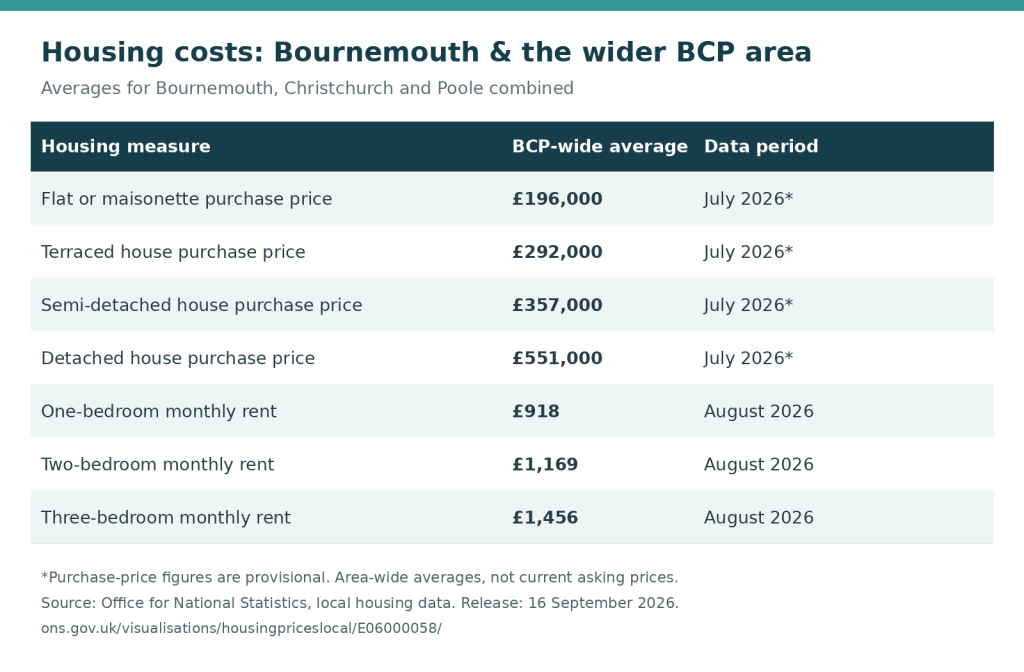
The Office for National Statistics reported an average house price of £310,000 in July 2026, with the figure provisional. Average monthly private rent across the same council area was £1,398 in August 2026.
The breakdown below gives a clearer indication of how costs differ by property size and type.
Rent or mortgage payments are only part of the calculation.
For 2026/27, a Band D property in Bournemouth Town has a published annual Council Tax charge of £2,429.46, including the town precept, before any applicable discounts or reductions. That is approximately £202.46 a month when spread across 12 months. Check the exact address and band, as charges vary by parish.
Alongside Council Tax, allow for:
Energy and water: investigate the property’s heating system, insulation and likely usage.
Broadband and mobile: check availability at the address, especially if working from home.
Transport: include commuting fares or fuel, insurance, parking and maintenance.
Property costs: establish any service charges, maintenance commitments and insurance requirements.
Family spending: obtain childcare and wraparound-care quotes before setting your budget.
The move itself: allow for removals, deposits, furnishings and any overlap between homes.
There is no single reliable monthly living-cost figure for every Bournemouth household. We’d build a budget around an actual shortlisted property and your own routine.
One advantage is the choice of outdoor leisure without an admission charge. Our free things to do in Bournemouth guide offers ideas for enjoying the coast and green spaces, although travel and parking may still cost extra.
Start with the kind of week you want to have.
Westbourne is worth exploring if independent shops, cafés and everyday convenience are priorities. Southbourne combines its own high street with access to the coast, although the distance to shops, beach and railway varies across the neighbourhood.
Boscombe and Pokesdown offer established shopping streets, seaside amenities and rail access around Pokesdown. Winton, Charminster and Moordown provide inland alternatives, with local businesses and residential streets.
For greener surroundings, investigate Talbot Woods and Queen’s Park. For central entertainment and apartment living, compare the town centre, West Cliff and East Cliff. Kinson and Northbourne offer further inland options.
Rather than choosing by reputation alone, compare the walk to groceries, your commute and the surroundings of each property.
Read our Best Areas to Live in Bournemouth guide for neighbourhood comparisons, housing types and practical trade-offs.
Living without a car may work well if your home, workplace and regular activities sit along convenient walking, bus or rail routes. It becomes a different proposition when your routine involves several destinations or late finishes.
Morebus serves Bournemouth and surrounding areas. Its network includes connections between neighbourhoods and destinations such as Poole, Castlepoint and the Royal Bournemouth Hospital. Check the current routes and timetables against your actual journey, including evenings and weekends.
Bournemouth also has rail connections to London Waterloo. If you are considering a longer-distance commute, check the train times and fares for your working pattern, then add the journey to the station and onward travel at the other end.
A town-centre or coastal address does not automatically mean a short walk to the railway. Try the full door-to-door journey before committing.
Drivers should do the same at their normal commuting time and confirm parking arrangements at both home and work.
For families, school places and childcare should be investigated early.
BCP Council advises prospective residents to contact its admissions team about school-place availability before buying or renting. Living within a catchment area does not guarantee that a place will be available.
Start with the council’s school catchment information. If your child is already at school, read the guidance on requesting a place during the school year.
For younger children, use the BCP Family Information Directory to research childcare, then ask providers directly about vacancies, hours and costs.
Look beyond the school journey too. Consider where children could play, attend activities and meet friends, and whether those trips fit around work.
Click HERE to view our moving to Bournemouth with children guide
Bournemouth’s strongest attraction is how readily outdoor time can become part of everyday life. Beaches, gardens and neighbourhood green spaces offer different ways to get outside, while restaurants, entertainment and local clubs provide reasons to stay connected throughout the year.
Our Bournemouth Gardens guide is a useful introduction to the green corridor running inland from the town centre.
The compromises deserve equal attention. Coastal areas can feel much busier on sunny weekends, parking needs careful investigation, and living near nightlife may bring noise. A quieter residential location may involve more travelling to reach the places you enjoy.
Housing also requires a realistic budget. An appealing purchase price or rent should be considered alongside commuting, bills and any building charges.
We’d visit a shortlisted area on an ordinary weekday and again in the evening. If possible, return outside the summer season to see how it feels when you are living here rather than visiting.
Renting before buying can give you time to understand which neighbourhood suits you. It is particularly worth considering if you are unfamiliar with Bournemouth or still establishing a working routine.
Balance that flexibility against the expense and effort of potentially moving twice. Use any rental period purposefully: try different areas, test journeys and work out which amenities you actually use.
Once you arrive, a regular activity can help a new place feel familiar. Explore our guides to tennis clubs and courts in Bournemouth or Bournemouth Run Club, checking current arrangements before attending.
Before committing to a home, make sure you can answer these questions:
Does the complete monthly budget work, including bills and travel?
Have you tried the commute at the time you would normally make it?
Are parking, broadband and property maintenance arrangements clear?
Have you checked school places and childcare where needed?
Have you visited the street at different times?
Can you comfortably reach the shops, services and activities you expect to use?
Moving to Bournemouth can bring the sea closer to everyday life. Choose a home that supports the practical side of your week, and you will be better placed to enjoy the reasons you wanted to move here in the first place.
If you enjoyed this, you may also enjoy:
Information checked: 14 October 2026. Housing figures relate to the periods stated and may be revised.


 Spanish
 Chinese (simplified)
 Dutch
Dutch French
 German
 Italian
 Norwegian
 Polish
 Romanian
 Russian